Hassan II Mosque: the cathedral of Islam built on the Atlantic
Built between 1986 and 1993 in Casablanca, the Hassan II Mosque is a vast Moroccan religious and cultural complex built partly above the Atlantic.
Inaugurated on August 30, 1993 in Casablanca, the Hassan II Mosque has a 190.50 m minaret according to its Foundation, a prayer room with 25,000 seats, an esplanade that can accommodate 80,000 people and an opening roof.
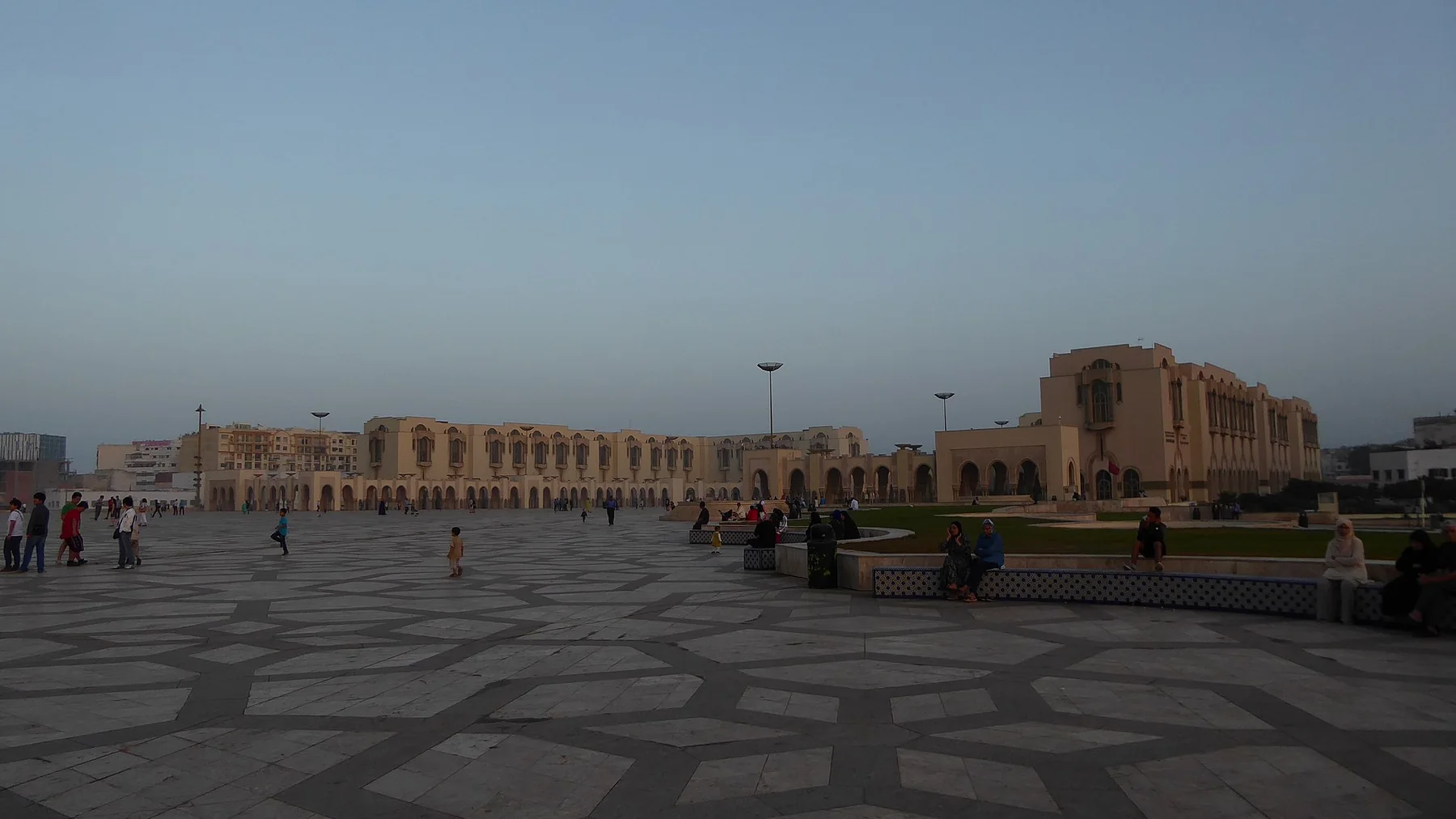
Imagine Casablanca on a clear night. On the seafront, a beam of light rises from the minaret of the Hassan II Mosque, which the Foundation indicates is 190.50 meters high above the prayer room. The esplanade borders the Atlantic and part of the structure extends towards the sea. In the room, glass openings recall this link with the ocean. Inaugurated in 1993, the complex combines Arab-Muslim architecture, Moroccan artisanal know-how and contemporary techniques.
A Koranic verse engraved in reinforced concrete
The idea of building a large mosque in Casablanca came from King Hassan II himself. In the speech he gave to announce the project in 1980, he cited a verse from the Koran: *"The Throne of God was on the water"* (surah 11, verse 7). This sentence should be taken literally literally: the king wanted the place of prayer to be built overlooking the Atlantic, so that the sea was visible beneath the faithful, as a physical reminder of divine omnipresence. This choice — mystical as well as aesthetic — determines everything: the location on the northwest coast of Casablanca, the construction techniques at sea, and the unique relationship between the monument and the natural elements that surround it.
Casablanca is not a historic city in the sense that Fez, Marrakech or Rabat are. It does not have a thousand-year-old medina or an Almohad mosque. It is an economic metropolis, based on its port and industrial function, the vast majority of whose urban fabric dates from the French protectorate (1912-1956) or independence. Hassan II, who reigned from 1961 to 1999, decided to anchor in the economic capital of Morocco a monument which was at the same time an act of devotion, a national emblem and a link between technical modernity and Moroccan artisanal tradition. The mosque will be its most visible architectural signature.
Michel Pinseau: the French architect who dreamed in Arabic
Hassan II chose a French architect to design the mosque: Michel Pinseau, born in 1924, who has worked in Morocco since the 1950s and is intimately familiar with the codes of Hispano-Moorish architecture. This choice is symbolically strong — and practically coherent. Pinseau does not approach the project as an importer of orientalist aesthetics: he starts from traditional Moroccan forms to rationalize them in reinforced concrete on the scale of an Olympic stadium monument. The vocabulary is that of the great Marinid and Almohad mosques – horseshoe arches, sculpted *sebka*, earthenware *zelliges*, cedar wood in moucharabieh – but the dimensions are those of a 20th century infrastructure.
The project began in 1986 and mobilized a considerable workforce for seven years: more than ten thousand workers and artisans, including a large proportion of artisans specialized in traditional Moroccan trades — *maalems* stucco sculptors, zellige mosaicists, cedar carpenters. The figure of 30,000 craftsmen is put forward for the entire project if we include the interior finishing phases. The most delicate works — the hand-carved stucco panels in the prayer room, the Carrara marble columns, the zelliges with millennia-old geometric patterns — lasted until the last year. The inauguration took place on August 30, 1993, on the eve of Mawlid (birthday of the Prophet), in the presence of delegations from all over the world.
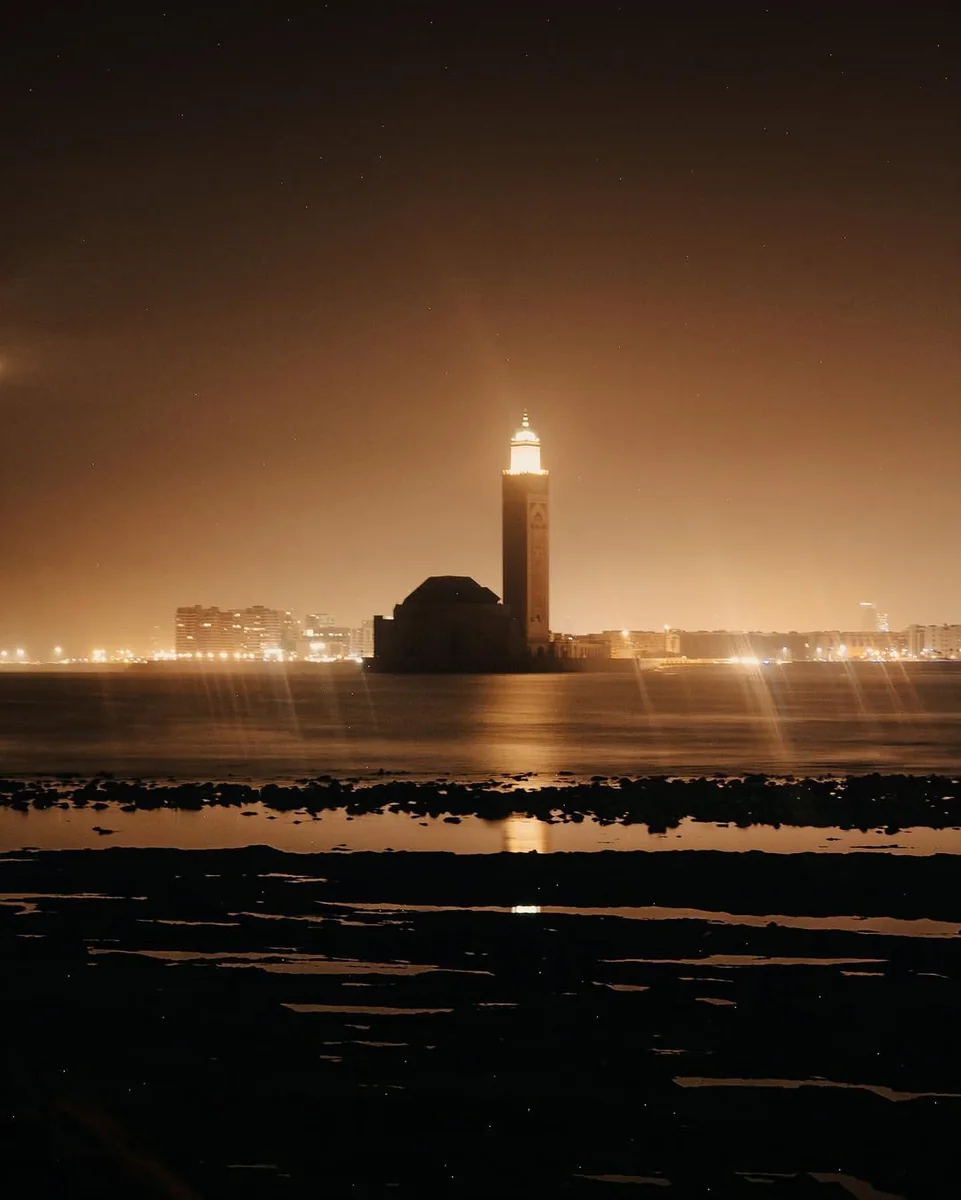
The minaret: 190.50 meters above the prayer room
The Hassan II Mosque Foundation gives the minaret a total height of 190.50 meters above the level of the prayer room and a footprint of 625 m². Its silhouette, covered in Moroccan geometric decorations, dominates the Casablanca seafront. A light device oriented towards Mecca completes the top of the minaret; operating hours may vary and are therefore not presented here as permanent.
Beneath the feet of the faithful, through a floor of glass, the Atlantic is there — a permanent reminder that the Throne of God was on the water.
Built on the ocean: the technical feat that makes the monument unique
About a third of the total area of the Hassan II Mosque — some 9,000 square meters of the 22,000 square meters covered by the building — is built on stilts above the waters of the Atlantic. It is this part, on the sea side, which accommodates part of the exterior esplanade and several annexes of the complex. The foundations sunk into the seabed required techniques comparable to those used for large offshore oil platforms: concrete piles drilled several meters into the underwater rock, elastomeric joints to absorb seismic movements, anti-corrosion treatments of the entire metal structure. The Atlantic Sea is a rough sea: engineers from the Bouygues firm, which is responsible for technical project management, had to calculate storm swell loads and coastal winds that could exceed 150 km/h. The mosque has weathered several severe winter storms since 1993 without the slightest reported structural incident.
Inside the main prayer hall, the glass floor above the sea remains one of the most stunning features of the building. The hall can accommodate 25,000 worshipers simultaneously — standing in traditional prayer rows — on these large translucent slabs through which water and light from the Atlantic filter depending on the time and weather conditions. In bad weather, you can see the foaming and splashing against the concrete piles. In dead calm, the surface of the water reflects the sunlight, streaking the ceiling with moving reflections. No other mosque in the world offers this sensory experience.
The figures of an extraordinary monument
The statistics from the Hassan II Mosque are difficult to absorb without relating them to concrete benchmarks. The indoor prayer hall can hold 25,000 people — the equivalent of the capacity of a medium-sized football stadium. The outdoor esplanade can accommodate an additional 80,000, bringing the total capacity of the site to around 105,000 worshipers during major prayers. The prayer hall measures 200 meters long by 100 meters wide — about four football fields side by side. The main building has a floor space of 20,000 square meters, excluding the esplanade. The 50 crystal and bronze chandeliers that illuminate the main prayer hall each weigh several tons. The 124 fountains and 41 ritual hammams (*woudou*) installed in the basements allow the ablutions of several thousand worshipers simultaneously.
- Total area of the site: 9 hectares (building + esplanade + gardens)
- Prayer room: 25,000 worshipers inside, 80,000 on the outside esplanade
- Minaret: 190.50 meters above the level of the prayer hall according to the Foundation
- Sunroof: approximately 1,300 m² sliding, opening in less than 3 minutes
- Glass floor above the ocean: 9,000 m² of the built area on stilts
- Craftsmen mobilized: around 30,000 over 7 years of construction (1986-1993)
- Marble: Tiznit onyx, Carrara marble, Atlas granite
- Night laser: beam pointed towards Mecca, visible 30 km at sea
Visit the Hassan II Mosque: what non-Muslims can see
The Hassan II Mosque organizes guided cultural tours accessible to non-Muslim visitors. Slots and prices may change depending on the season, days of prayer and religious events: they must be checked on the official Foundation website before the visit. Respectful attire is required and the instructions communicated on site must be followed.
The visit begins with the ablution room (*woudou*), an immense underground gallery with marble columns, with its 41 ritual fountains — a piece of architecture in its own right, rarely photographed but of a sober and regular beauty. It continues in the main prayer room, where the guide details the artisanal techniques: stucco hand-carved by *maalems* from Fez, zelliges from Salé, cedar wood from the Middle Atlas forest worked by carpenters from Meknes, marble from Agadir polished by hand. The glass floor above the Atlantic is visible from several points in the nave. On a clear day, the afternoon light passes through the rose windows and woodwork, creating shadow plays on the columns reminiscent of the interior of the Cathedral of Cordoba — which the mosque cites, if not directly, at least in spirit.
Interior art: when Moroccan artisans compete with their own past
What is striking in the prayer room, beyond the amazement of the dimensions, is the precision of the details. The sculpted stucco panels that run five meters high on the walls were made by hand by teams of *maalems* – master craftsmen – coming mainly from Fez, a city which retains the most active craft guilds in Morocco. Each *sebka* pattern, each plant arabesque, each *thuluth* style calligraphy reproduces models taken from Marinid architecture of the 13th and 14th centuries, but with a technical accuracy that modern materials - fine lime wash on frames, precision tools - allow to bring to a level of finesse superior to the medieval originals. This paradox - a tradition which, for the first time in centuries, has the means to surpass itself - is one of the intellectual threads of Pinseau's project.
The zelliges cover several thousand square meters of soil and foundations. They were made in Salé, a town neighboring Rabat, in workshops which have been perpetuating the technique of geometric earthenware mosaic since the Middle Ages: each glazed ceramic tile is cut by hand with chisels, then assembled cold in plaster molds according to the geometric patterns calculated with a ruler and compass. The dominant colors — green, cobalt blue, white, ocher — are those of classic Moroccan ceramics, but the palette has been slightly modernized to accommodate the intense artificial lighting that the size of the building demands. The result is a floor and walls that vibrate differently depending on the time and angle of light — an optical experience that photographs poorly convey.
The Hassan II Mosque in 2026: heritage, tourism and future
More than thirty years after its inauguration, the Hassan II Mosque remains a major place of prayer, cultural visits and the transmission of traditional arts in Casablanca. Its management is the responsibility of the Foundation of the Hassan II Mosque of Casablanca, which publishes official information on visits, the complex and its equipment. Its location on the edge of the Atlantic requires particular attention to the maintenance of materials exposed to sea spray.
What the Hassan II Mosque says about Casablanca in 2026 is something rarely articulated in tourist guides: Morocco's most modern and secularized city — that of business districts, shopping centers, jazz clubs and French high schools — carries at its heart one of the most imposing religious buildings ever built in the contemporary Islamic world. This paradox is not a contradiction: it is Casablanca. A city that has always been able to hold together economic modernity and Moroccan cultural identity without ever sacrificing one to the other. The laser beam that rises each night towards Mecca from the corniche is perhaps the best metaphor for this productive tension — a line of light between the Atlantic and the Orient, between yesterday and tomorrow.