Jardin Majorelle Marrakech: blue, Yves Saint Laurent and the history of the most famous garden in Morocco
From Jacques Majorelle, who began his exotic plantations in 1922 and established the garden from 1924, to Yves Saint Laurent and Pierre Bergé who saved it from a real estate project in 1980, the Majorelle Garden has become a major cultural place in Marrakech.
The Majorelle Garden in Marrakech, developed by Jacques Majorelle from the 1920s then saved by Yves Saint Laurent and Pierre Bergé in 1980, houses the Pierre Bergé Museum of Berber Arts and adjoins the YSL museum opened in 2017.
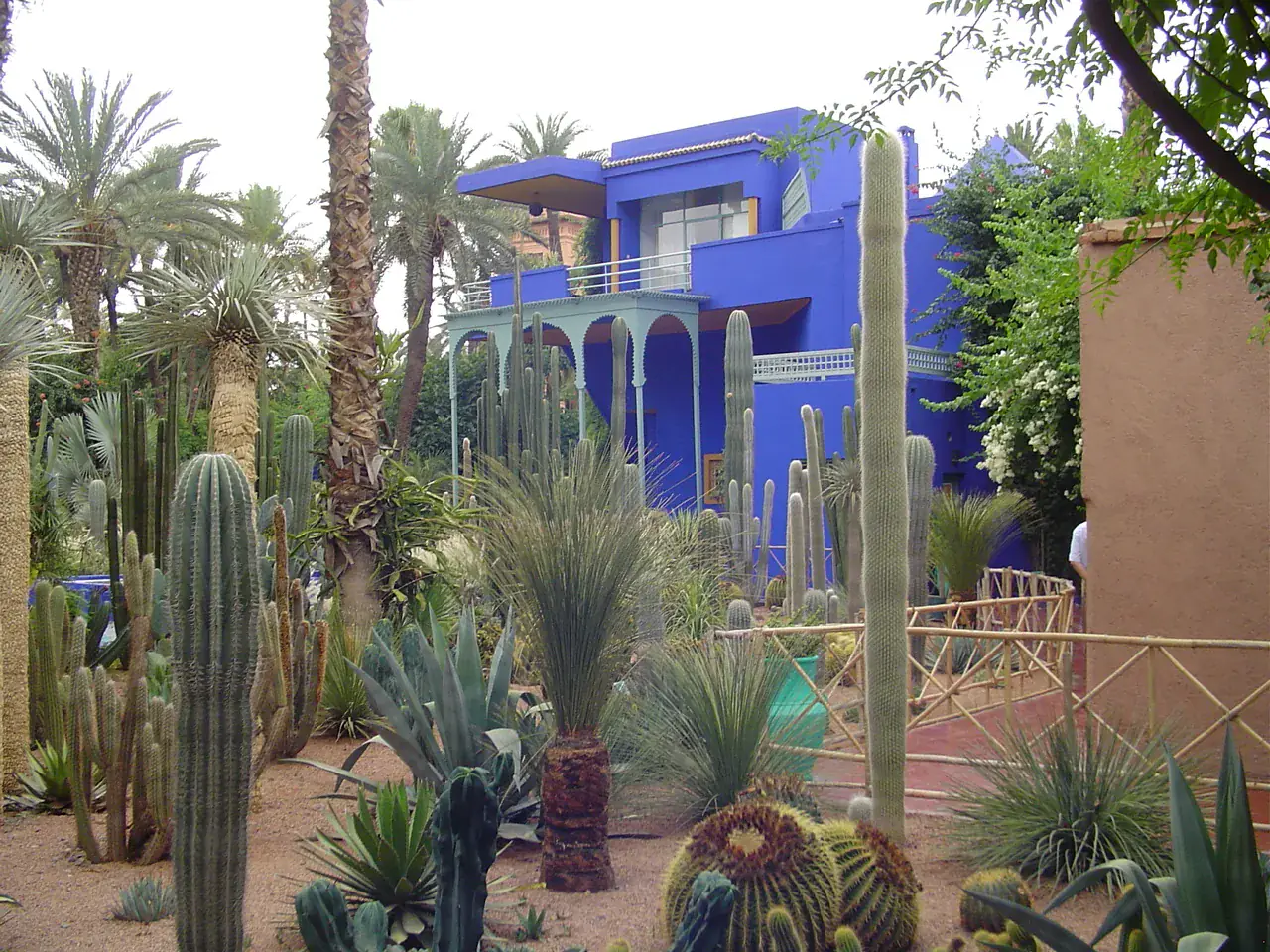
Rue Yves Saint Laurent, in the Guéliz district of Marrakech - the new town laid out by the French Protectorate at the beginning of the 20th century, a few hundred meters from the medina and its thousand-year-old ochres - a color stops you before you even cross the threshold. This blue is not the blue of the North African sky on a clear day, nor the blue of overseas nor that of Fez earthenware: it is an intense, almost electric cobalt blue, a blue that we see nowhere else in Moroccan nature and which yet, for a hundred years, seems to be part of the most natural landscape in the world. Inside the walls, bamboo rustles on the red gravel paths. Column-high cacti cast their jagged shadows on the painted walls. A water lily pond reflects the palm fronds and the sky in water so still that it resembles a mirror placed on the ground. And everywhere, on the planters, the pergolas, the ceramic pots and the Art Deco villa which sits in the center of this plant ensemble, this color. *Majorelle Blue.* The Majorelle Garden is one of the most photographed places in Morocco — and one of the few where reality goes beyond the image.
Jacques Majorelle (1886-1962): the orientalist painter who planted a garden
Jacques Majorelle was born in Nancy on March 7, 1886, into a family with an artistic tradition: his father, Louis Majorelle, was one of the most recognized cabinetmakers and decorators of the School of Nancy, the Lorraine Art Nouveau movement. This artistic heritage had a profound impact on the young Jacques, who trained in Paris at the Beaux-Arts and very early developed a taste for pure color and plant forms. In 1919, he arrived in Morocco for health reasons - he was advised a dry climate - and settled in Marrakech. What he discovered electrified him: the light of the High Atlas, the geometry of the kasbahs, the fabrics dyed with indigo in the souks, the interior gardens of the riads. He won't leave. For the next forty years, he traveled across Morocco to paint landscapes, portraits of Berber women, scenes of caravan life - an abundant and technically virtuoso orientalist work, today preserved in several museum collections.
In 1923, Majorelle acquired land in the Guéliz district — the new town still under development — and began building something unique there. His first residence on the land, the *Villa Bou Saf Saf*, dates from 1924. But it was in 1931-1932 that he had the Art Deco villa built, to the plans of the architect Paul Sinoir, which would become the emblem of the garden: a cubist volume with clear proportions, with windows framed in painted wood, with refined decorative lines. In 1937, he had the entire villa and garden structures painted in this intense cobalt blue that he had developed and which he registered as a trademark: *Majorelle blue*. The architect of the botanical garden that grows around the villa is Majorelle himself: for thirty years, he enriched the plantations with species from five continents - cacti from South America, palm trees from sub-Saharan Africa and Asia, bamboo from China, tropical flowers. In 1947, convinced that he had created something remarkable enough to be shared, he opened the garden to the public. It is one of the first private botanical gardens open to visitors in Morocco.
Paul Sinoir's Art Deco villa (1931): architecture and color
The villa that the architect Paul Sinoir designed for Majorelle between 1931 and 1932 belongs to the Mediterranean colonial Art Deco movement that the French Protectorate spread to Morocco in the 1920s and 1930s. It is sometimes called *Villa Oasis* in later sources. Its formal vocabulary is that of Art Deco: stacked cubist volumes, terraced roofs, wooden mullioned windows, no decoration sculpted in relief but surface effects obtained by the colors and textures of the coatings. Sinoir adapts this vocabulary to the Moroccan context: the wooden shutters of the windows evoke the *moucharabieh* of Arab architecture, the tight proportions respond to the need for shade and freshness in a semi-arid climate. When Majorelle had it painted cobalt blue in 1937, the villa transformed from a beautiful colonial home to an artistic statement. It becomes the chromatic focal point of a garden in which the greens, reds and yellows of the plants are now organized around this pivotal color.

The botanical garden: cacti, ponds and plants from five continents
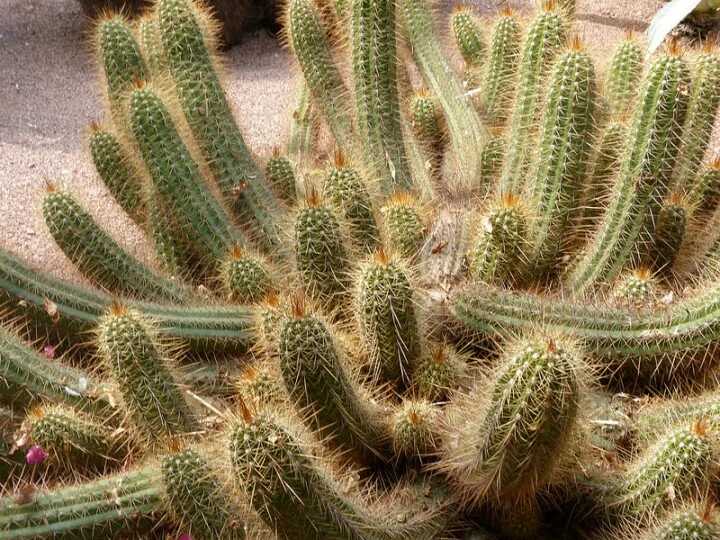
The garden that Majorelle built around his villa for more than thirty years covers an area of approximately 8,000 square meters — a relatively contained space, but with exceptional plant density. He cultivates some 300 species of plants from five continents, with a marked predilection for cacti and succulents from South America and North Africa, palm trees of all varieties, bamboos whose clumps create corners of shade and rustling sound, and tropical flowering plants which give the garden spots of red, orange and purple between the dominant blues and greens. Basins and irrigation canals structure the space according to a logic that is both decorative and functional: water was the rare resource that every Moroccan garden organized around it. Water lilies bloom there. Carp slide into the pools. Birds – there are more than fifteen endemic species from North Africa in the garden's ornithological list – find refuge in the dense vegetation.
After the death of Jacques Majorelle on October 14, 1962 in Paris, following a fractured femur, the garden experienced a period of decline. His heirs and assigns have neither the resources nor the attention necessary to maintain a garden of this botanical complexity. The plantations are deteriorating. The villa is falling into disrepair. In the late 1970s, real estate projects planned to buy the land to build a luxury hotel — a very real threat in the expanding Marrakech of that period.
Yves Saint Laurent and Pierre Bergé saved the garden in 1980
Yves Saint Laurent's relationship with Marrakech began in 1966, when the fashion designer and Pierre Bergé, his companion and business partner, discovered the city during a trip. Saint Laurent, already at the peak of his creative career, was immediately struck by the light, colors and visual intensity of the ocher city. They bought a property there — the *Dar es-Saada*, then other residences — and Marrakech became a refuge for Saint Laurent, a direct source of inspiration for his collections, and a permanent address in his life shared between Paris and Morocco. In 1966, during one of their walks in Guéliz, they discovered the Majorelle Garden — at the time still accessible to the public but already visibly in distress. Saint Laurent will remember it with particular intensity.
In 1980, learning that the land was threatened by a real estate construction project, Yves Saint Laurent and Pierre Bergé bought the whole thing – the villa, the garden and its plantations – and undertook a complete restoration. They replanted the extinct species, consolidated the structures, repainted Majorelle blue on the villa and the planters. Under their direction and thanks to the financial means that their position allowed them to mobilize, the garden returned in a few years not only to its state before the decline but to an organization and botanical richness superior to what it had known under Majorelle himself. Saint Laurent will use the garden - and his adjacent villa, which he occupies during his stays in Marrakech - for twenty-eight years, until his death.
In the Majorelle garden, Saint Laurent found, in his own words, an inexhaustible source of inspiration and colors that he described as unique in the world.
The Berber Museum in the villa (2011): thirty thousand years of Amazigh culture
After the death of Yves Saint Laurent in 2008, Pierre Bergé created the Pierre Bergé — Yves Saint Laurent Foundation, which takes charge of the management of the garden and its cultural missions. In December 2011, the Art Deco villa was transformed into a museum: the *Pierre Bergé Museum of Berber Arts* — initially inaugurated under the name of the Berbère Museum. The collection presented, put together by Pierre Bergé and Yves Saint Laurent over their Moroccan decades, brings together several hundred pieces of Berber crafts and art: silver jewelry from the High Atlas and Anti-Atlas, high wool carpets with geometric patterns, ritual pottery, embroidered clothing, musical instruments, ceremonial adornments. It is one of the most remarkable private collections of Berber art ever assembled, and one of the few to be permanently exhibited and accessible to the public in Marrakech.
The choice to install this Berber museum in Majorelle's villa is not insignificant. Jacques Majorelle himself devoted a large part of his painted work to the Berber populations of Morocco - women of the Atlas, scenes of rural souks, landscapes of the southern valleys. The continuity between the French orientalist painter and the collection of Berber art constituted by two French aesthetes is thus underlined architecturally: the same villa, the same blue, two different views on the same culture. The museum was renamed *Pierre Bergé Museum of Berber Arts* in 2020, after the death of Pierre Bergé in 2017.
The Yves Saint Laurent Museum Marrakech (2017): fashion and memory
In October 2017, a new building opened its doors a few meters from the Majorelle Garden: the *Yves Saint Laurent Marrakech Museum* (often abbreviated MYSLM). Designed by architects Studio KO — Karl Fournier and Olivier Marty — the building dialogues with the architectural heritage of the neighboring garden: clad in terracotta-colored terracotta bricks with geometric patterns inspired by Berber weaving, it fits into the landscape of Guéliz without erasing its texture. Inside, the museum traces the creative career of Yves Saint Laurent through haute couture pieces, preparatory drawings, costume models, runway photographs and personal archives. Saint Laurent's relationship with Marrakech and Morocco occupies a special place in the permanent journey: its collections inspired by the colors of the city, the dresses where we recognize the Majorelle blue, the orange of the ramparts, the gold of the souks.
The museum also has a temporary exhibition space which regularly welcomes contemporary Moroccan and international artists. Its creation strengthened Marrakech's position as a cultural destination in the full sense of the term — not only a city of medina and built heritage tourism, but a place of active cultural production and dissemination. The ensemble formed by the Majorelle Garden, the Berber Museum and the Yves Saint Laurent Museum today constitutes one of the most coherent and most visited cultural centers in Morocco.
Visiting the Majorelle Garden: practical advice and what you will discover
- Location: rue Yves Saint Laurent, Guéliz district (new town), about 2 km on foot from Djemaa el-Fna square — accessible by small taxi from the medina in 10 minutes
- Tickets: entry to the garden and the Berber Museum are sold separately; the Yves Saint Laurent Museum (immediate neighbor, separate building) has its own ticket — plan a separate budget for each visit
- Hours: the official website indicates daily opening from 8 a.m. to 6:30 p.m., with last access at 6 p.m. Online reservation through the official ticket office is mandatory; check times when booking, as they may change
- What we see in the garden: the blue Art Deco villa, the water lily ponds, the avenues of bamboo and giant cacti, the Yves Saint Laurent memorial in the rose garden
- Berber Museum (in the villa): Berber silver jewelry, High Atlas carpets, embroidered clothing, ritual pottery — one of the most beautiful collections of Amazigh arts in Morocco
- Yves Saint Laurent Museum Marrakech (neighboring building, 2017): haute couture dresses, preparatory drawings, archives of Saint Laurent's career and temporary exhibitions of contemporary art
- Photograph the garden: blue walls and cacti give their best images early in the morning under low light; the interior of the villa is best photographed from the terrace in the late afternoon
The Majorelle Garden in 2026: heritage, color and living memory
The official centenary press kit indicates that more than 1.2 million people visited the Majorelle Garden in 2023. The official website today describes a 9,000 m² garden. This attendance requires the Majorelle Garden Foundation to carefully manage access and conservation, in particular through slots reserved online. Botanical teams maintain the plantations and ponds, while the villa maintains the emblematic color desired by Jacques Majorelle.
What the Majorelle Garden says about Marrakech in 2026 is something that the ocher medina and traditional riads do not say in the same way: that this city was also, in the 20th century, a laboratory for exchanges between cultures, between aesthetics and between creative identities. A painter from Lorraine who creates a color like a signature. A Parisian fashion designer who saves a garden and places his ashes there. A Franco-Moroccan foundation which installs Berber arts between two bamboo groves. *Majorelle blue* is not a foreign color plastered on a southern city — it is the result of a century-long conversation between an artist and a landscape that transformed him as much as it transformed him. Under the light of Guéliz, late in the afternoon, when the shadows of the palm trees begin to lengthen on the gravel paths and this blue imperceptibly turns to indigo, we understand it without needing to explain it.