Ibn Battuta of Tangier: the greatest traveller the medieval world ever produced
In 1325, a 21-year-old law graduate left Tangier on a pilgrimage. He did not come home for 29 years — having covered 117,000 kilometres across four continents and dictated a travel book that still shapes our understanding of the 14th-century world.
Born in Tangier in 1304, Ibn Battuta travelled 117,000 km across 44 countries over 29 years. His travel book, the Rihla, remains one of the richest sources on 14th-century civilisation. Discover his story and his city.
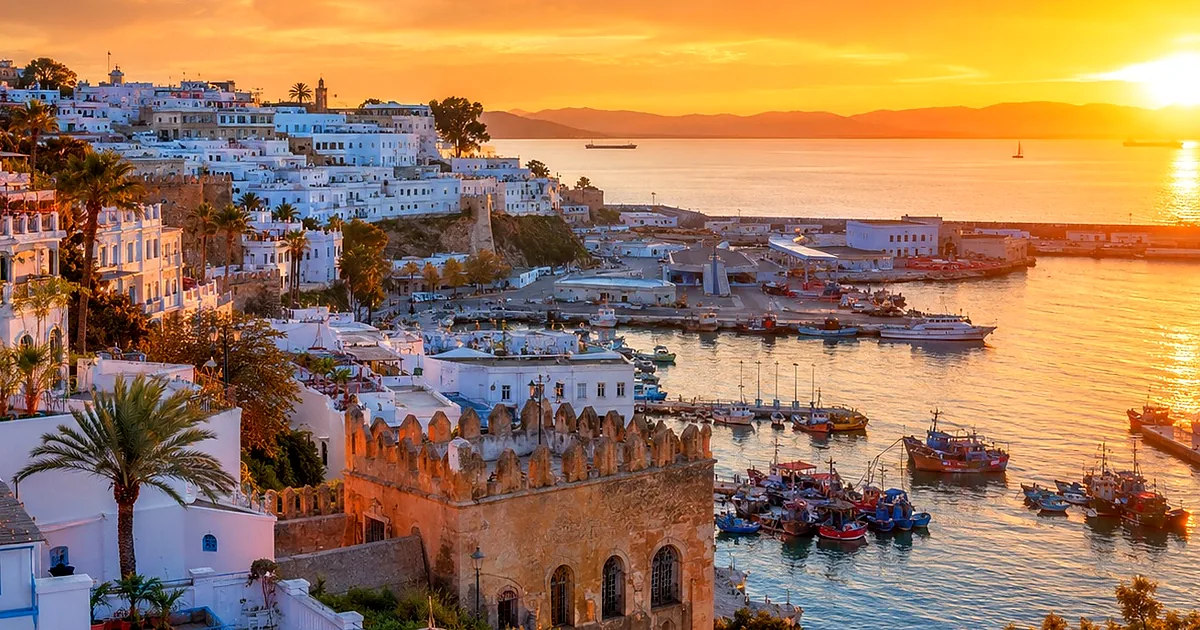
Picture Tangier in the early summer of 1325. On the hillside above the bay, in the tight whitewashed lanes of the medina, a young man of twenty-one is packing a saddlebag. His name is Abu Abdallah Muhammad Ibn Battuta. He is the son of a family of Islamic legal scholars, and he is setting out on the *hajj* — the pilgrimage to Mecca that every Muslim aspires to make at least once. Nothing about this departure suggests that he will not be back within a year. He will not return to Tangier for twenty-nine years. By the time he does, he will have crossed the equivalent of three times the circumference of the Earth, served as a judge in the court of the Delhi Sultanate, been shipwrecked off the coast of India, survived a plague and a Saharan sandstorm, and accumulated 117,000 kilometres of travel — a distance no other recorded individual would match before the age of steam.
Tangier, 1304: the city that made the greatest medieval traveller
Ibn Battuta was born on 24 February 1304 in Tangier, then a busy trading city on the Strait of Gibraltar under the Marinid dynasty of Morocco. His full name — Abu Abdallah Muhammad ibn Abdallah al-Lawati al-Tanji Ibn Battuta — records his Berber Amazigh origins, from the Lawata tribe, and his city of birth. His father and uncles were *qadis*: Islamic judges trained in Maliki jurisprudence, the school of Islamic law predominant across North Africa and Muslim Iberia. That legal pedigree would prove to be Ibn Battuta's most reliable passport. Across the entire medieval Islamic world, a trained Maliki jurist was welcomed as a scholar of the first rank — offered lodging, meals, stipends and official positions by sultans who competed to attract learned men to their courts.
Tangier at the time of his birth was not a provincial backwater. It sat at the hinge between Africa and Europe, with the Andalusian port of Tarifa visible on a clear day across eleven kilometres of open water. Goods, scholars, soldiers and ideas moved constantly through the strait. The city had absorbed waves of Andalusian refugees fleeing the Christian Reconquista, and it hummed with the cosmopolitan energy of a place where three continents were always in earshot. It was a fitting birthplace for the man who would eventually describe — with a precision that still surprises historians — the courts of Constantinople, the mosques of Timbuktu, and the junks of Canton.
Twenty-nine years on the road: tracing the Moroccan explorer's extraordinary route
The journey began straightforwardly enough. Leaving Tangier in June 1325, Ibn Battuta crossed North Africa on the coastal road through Tlemcen and Tunis, entered Egypt at Alexandria, and reached Mecca in October 1326 — completing his first *hajj* after sixteen months of travel. But instead of returning home, he turned north into Syria and Palestine, then back south to Mecca for a second pilgrimage. Something had changed. The road itself had become the destination. From Mecca he pressed eastward into Iraq and Persia, then south down the Arabian coast to Yemen and across the Indian Ocean to the Swahili coast of East Africa, reaching as far south as modern-day Tanzania. He was twenty-four years old, and he had already seen more of the world than most people of his era would see in a lifetime.
The middle decades of his travels brought him to the farthest extremities of the medieval Islamic world and well beyond. He crossed the Black Sea to the Golden Horde — the Mongol empire of the southern Russian steppes — and visited Constantinople at the invitation of the Byzantine emperor Andronikos III around 1332, producing one of the few detailed Arabic accounts of the Byzantine capital before its Ottoman conquest in 1453. From the steppes he moved east through Central Asia to Delhi, where the Sultan Muhammad bin Tughluq appointed him *qadi* of the Indian capital. He remained in India for eight years, 1334 to 1341, before sailing for China via the Maldives, Ceylon and Malacca. At the port of Quanzhou, in southeastern China, he described the vast junks, the paper money, the silk markets and the customs system with a precision that later scholars verified against Chinese sources.
The journey home was no less eventful. Sailing back through the Indian Ocean, he was caught in a violent storm off the coast of India that wrecked the vessel carrying his gifts and luggage. He passed again through the Persian Gulf and Anatolia — where the Ottoman sultanate was still in its infancy — and arrived back in Tangier in 1349, to find that his mother had died of plague only months before his return. He stayed barely long enough to grieve. Within a year he was on the road again: south into Andalusia, where the Nasrid kingdom of Granada still held out against the Castilian Reconquista, then back to Morocco and south across the Sahara to the Mali Empire of Mansa Suleyman, reaching Timbuktu on the Niger River in 1353. It was there — at the farthest point of his last journey — that the great arc of his travels finally closed. He was fifty years old.
In twenty-nine years on the road, Ibn Battuta crossed more of the Earth's surface than any other recorded individual before the age of steam — and wrote it all down from memory.
The Rihla travel book: how a Moroccan explorer mapped the 14th-century world
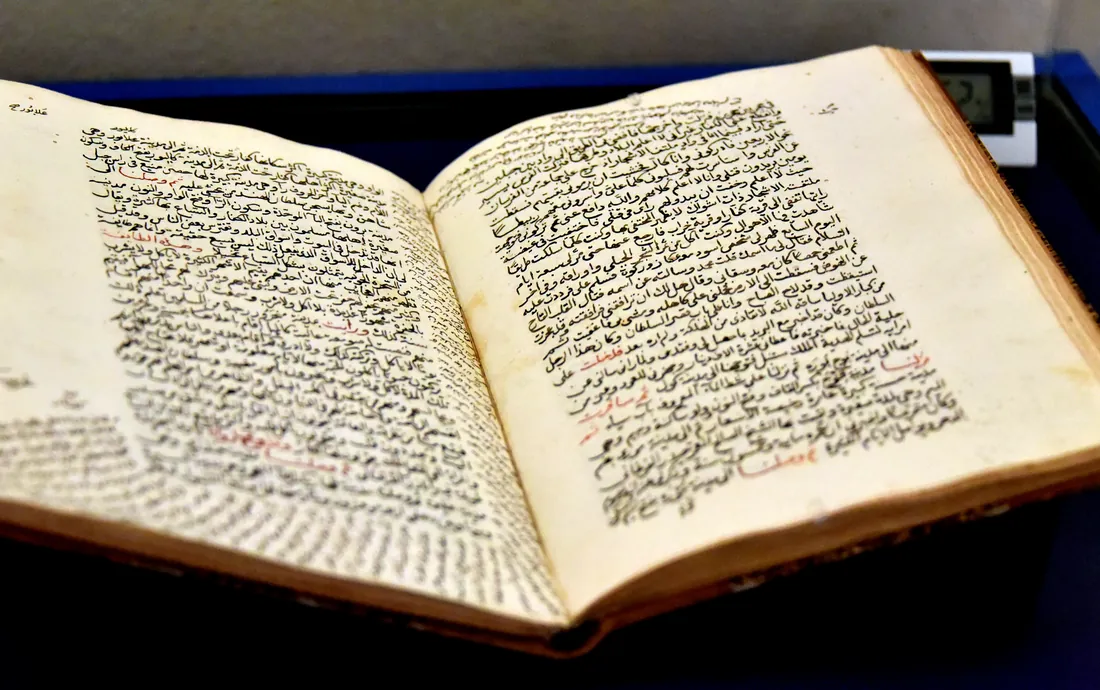
In 1354, back in Morocco and at the court of the Marinid sultan Abu Inan Faris in Fez, Ibn Battuta dictated his account to Ibn Juzayy al-Kalbi, a learned Andalusian attached to the royal court. The collaboration is openly acknowledged in the text: Ibn Juzayy states in his preface that he polished the prose without altering the facts reported by the traveller. Ibn Battuta had kept no diary — his account rested entirely on a memory that scholars, comparing his descriptions with independently documented sources, have found remarkably reliable. The full title of the work is *Tuhfat al-nuzzar fi ghara'ib al-amsar wa-'aja'ib al-asfar* — "A Gift to Those Who Contemplate the Wonders of Cities and the Marvels of Travelling". It is known universally as the *Rihla*: simply, "The Journey".
As a historical source, the *Rihla* is without parallel for the 14th century. His account of the Mali Empire under Mansa Suleyman, written in 1352–53, remains one of the foundational references for the medieval history of sub-Saharan Africa. His description of the Maldives — where he served six months as *qadi* — is the oldest detailed ethnographic portrait of the archipelago. His notes on the Black Death reaching North Africa and his observations on the plague's devastation across the Near East in the 1340s constitute an eyewitness record of one of history's most catastrophic events. The 20th-century historians who systematically cross-checked his itinerary against local chronicles, architectural surveys and archaeological records found that the overwhelming majority of his factual claims held up — a remarkable achievement for a text composed entirely from memory across three decades of travel.
Ibn Battuta's tomb in Tangier: where to find the city's greatest son today
Tangier has not forgotten the man who put it on the medieval map. Ibn Battuta died in Morocco around 1368–69, most likely in Tangier, where his tomb (*zaouia*) stands in the medina not far from the Grand Mosque. It is a modest place — a white marble slab inside a small chapel — but Tangier residents visit it regularly, and it has the quiet gravity of a site that the city genuinely considers its own. The Ibn Battuta Square on Boulevard Mohammed V is the main hub of the modern city centre. The Kasbah Museum (*Dar el-Makhzen*), a former royal palace in the upper medina, holds an exhibition on the history of Tangier that places Ibn Battuta's journey in its geographical and political context — with reproductions of the *Rihla* manuscripts and historical maps tracing his routes.
- Ibn Battuta's tomb in the medina — look for the small Sidi Ibn Battuta mosque, roughly 200 metres from Bab el-Fahs gate
- Ibn Battuta Square on Boulevard Mohammed V — the starting point for the city's modern tram circuit and a lively evening gathering place
- The Kasbah Museum (Dar el-Makhzen) — permanent collection with medieval maps, Rihla manuscript reproductions and Tangier's full history from Phoenician times to independence
- The Librairie des Colonnes on Boulevard Pasteur — one of Morocco's oldest bookshops, which stocks multiple editions of the Rihla in French, Arabic and English
- The port of Tangier-Ville, from which the Strait of Gibraltar is visible — the same strait Ibn Battuta crossed in June 1325 to begin his 29-year odyssey
Why Ibn Battuta still matters: the Moroccan explorer as a figure for our own times
The world Ibn Battuta moved through — the 14th century — was one of the most turbulent in human history. The Black Death killed between a third and half the population of Eurasia between 1347 and 1351. The Mongol empires that had briefly unified the overland routes from China to Eastern Europe were fragmenting. The Marinid dynasty of Morocco was already in slow decline. And yet, reading the *Rihla*, what comes through above all is not catastrophe but curiosity — an appetite for the world so persistent that it survived plague, shipwreck, political imprisonment and personal grief. Ibn Battuta learned Persian, Turkish and possibly some Mandarin. He married at least ten times on the road, fathering children he barely knew across four continents. He served under sultans of a dozen different dynasties without losing the quality that defined him: his refusal to accept any single place as the limit of his understanding.
What makes Ibn Battuta remarkable, beyond the sheer scale of his distances, is the quality of his gaze. He is an Islamic scholar who is nonetheless genuinely curious about Buddhist temples in Southeast Asia, the legal customs of the Maldivian matriarchy, and the trade infrastructure of the Chinese ports. He judges — he is more at ease with Islamic practice than with other traditions — but he does not dismiss. He admires the generosity of African kings, the efficiency of Chinese merchants, the jurisprudence of Indian scholars. This absence of contempt for the unfamiliar is rarer than it sounds in any century. In 2026, as borders tighten and suspicion of the foreign becomes politically useful again, the life of a man born in Tangier in 1304 who spent thirty years as a welcomed stranger in forty-four countries reads less like ancient history and more like a corrective. Visit his city. Stand at the Kasbah above the bay he sailed from. Read a few pages of the *Rihla*. The world he described — curious, interconnected, and still capable of hospitality — is not entirely lost. It simply takes looking for.