Chefchaouen, the blue city of the Rif: history, colors and what to see
Founded in 1471 as a Berber fortress, Chefchaouen became a refuge for exiles from Andalusia — and a medina whose indigo walls continue to intrigue the world.
Why is Chefchaouen blue? Founded in 1471 by Moulay Ali Ben Rachid, refuge for Andalusians driven out by the Reconquista, the blue city of the Rif hides a history as rich as its cobalt facades.
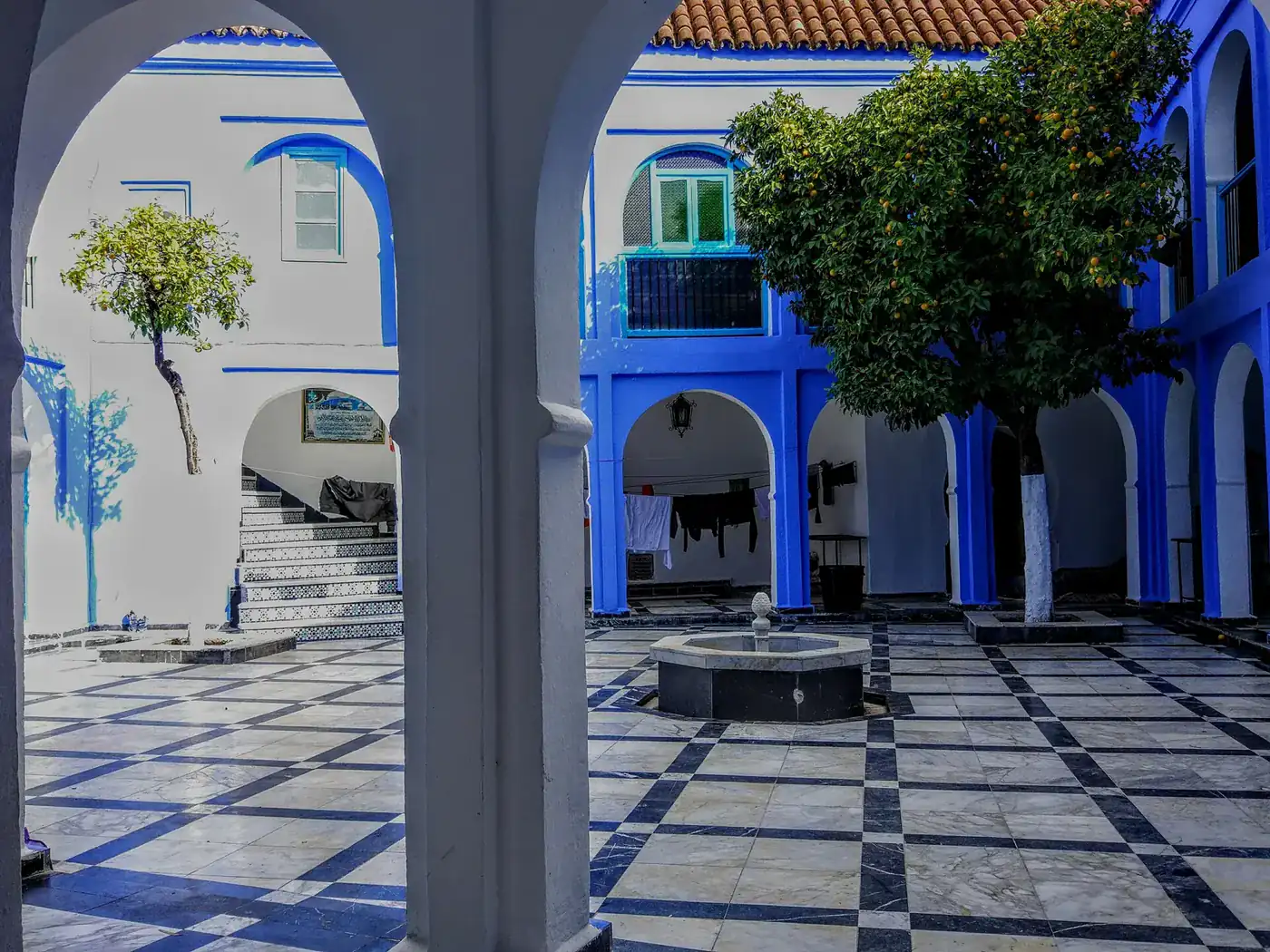
Imagine Chefchaouen on a November morning, when the low clouds hang over the crests of the Rif and the medina wakes up in a pearly light. The alleys are deserted at six o'clock - the cats of Outa el-Hammam square still reign over the damp cobblestones. Then the light rises and the walls are revealed: a blue that is not uniform, not monochrome, but a monochrome of sixty shades where cobalt rubs shoulders with indigo, lavender borders on turquoise, and certain facades turn almost white under the midday sun. Much has been written about this color. There has been much speculation about its origin. What we know with certainty is that it does not fall from the sky: it comes from a history spanning more than five centuries, woven from wars, exiles, memories and political choices.
Chefchaouen in 1471: a fortress on the heights of the Rif
The city of Chefchaouen - whose name comes from the Berber *Icherqiwen*, "the horns", in reference to the two mountain peaks which dominate the site - was founded in 1471 by Moulay Ali Ben Rachid, leader of the Moroccan resistance against Portuguese expansion on the Atlantic coast. The geopolitical context is tense: the Portuguese have held Ceuta since 1415 and are advancing towards the south. Moulay Ali Ben Rachid chose this rocky promontory at an altitude of 600 meters, lost in the Rif mountains, to build a *kasbah* - an entrenched camp which would serve as a rear base for incursions against the Portuguese garrisons of Ksar el-Kébir and Larache. The position is strategic: inaccessible by the plain, resupplied by the mountain roads that the Riffians have mastered for generations.
The original town is small — a few hundred inhabitants, an adobe wall, a mosque. But its foundation coincides with one of the most important upheavals in Mediterranean history: the end of the Iberian Reconquista. In 1492, Granada fell under the Catholic Kings Isabella of Castile and Ferdinand of Aragon. In 1609-1614, the *Moriscos* — the last forcibly converted Muslims — were definitively expelled from Spain. Between these two dates, and even before, thousands of Andalusian families fled to the Maghreb. Many choose Chefchaouen.
The refuge of the Andalusians: when Granada settled in the Rif
The Andalusian exiles who arrived in Chefchaouen in the 15th and 16th centuries did not come empty-handed. They bring with them their architecture, their artisanal know-how, their music - *gharnati*, Andalusian music still played today in the cafes of the medina - and their social organization. They settled in distinct neighborhoods, built patio houses inspired by the residences of Granada and Toledo, and dug irrigation canals, some of which are still visible between the Ras el-Maa spring and the center of the city. The medina of Chefchaouen, as it exists today in broad terms, is largely their work: the stepped alleys which wind in hairpins, the facades with sculpted frames, the *dars* (houses closed on a central patio) - all this comes from Andalusia.
Among these exiles, one community plays a particular role in the history of the blue color of Chefchaouen: the Sephardic Jews. Driven from Spain by the Alhambra Decree in 1492 — the same royal edict that put an end to Granada — Iberian Jewish families settled in Chefchaouen and constituted a flourishing community there until their mass emigration to Israel in the 1950s. These Sephardic Jews still speak *haketia*, a medieval Judeo-Spanish which survives in a few Moroccan families. And some local historians credit this community with introducing the tradition of painting walls blue.

Why is Chefchaouen blue? The four theories
The question is direct. The answer, alas, is not. No archival document fixes precisely the moment when the walls of Chefchaouen began to turn blue, nor clearly explains the cause. Four theories are circulating — all partially founded, none definitive.
- The Jewish tradition of *tekhelet*: in halakha (Jewish law), blue — originally obtained from a sea snail, *hilazone* — is a sacred color, symbol of the divine presence. Certain Sephardic Jews would have perpetuated in Chefchaouen the custom of dyeing the facades blue as a reminder of this spiritual dimension. This theory is the one most readily adopted by local guides, but its documentary basis remains thin.
- The freshness and the mosquitoes: a more pragmatic explanation – and widely spread among the inhabitants of the medina – relates to the color itself. Pastel blue reflects light, keeping interiors cooler in summer. Some add that blue lime repels mosquitoes. Studies in the physics of materials partly confirm the role of color in the thermal regulation of facades, but the mosquito argument remains anecdotal.
- The revival of the 1930s: several Moroccan historians place the spread of blue not at the time of the Andalusian exiles but in the 1930s, when Chefchaouen, occupied by the Spanish protectorate since 1920, began to see its first foreign visitors. Blue would partly be a conscious aesthetic response by residents to this influx of outside eyes – a way of distinguishing their city.
- Tourism marketing in the 1990s-2000s: the most radical hypothesis, put forward by certain researchers in cultural geography, is that the standardization of blue is recent - after the 1990s - and that it has accelerated with digital photography and social networks. Photos from the 1970s and 80s show a medina where white and ocher dominate as much as blue. The blue would have “won” by tourist selection.
The most probable reality is a superposition of all these explanations: a Sephardic-Andalusian origin for the first blue facades, a local thermal logic which perpetuated the practice, and a recent tourist amplification which has homogenized and intensified the color. Today, the municipality of Chefchaouen actively encourages homeowners to maintain and renew blue paint — blue has become an economic asset as well as a cultural heritage.
The blue of Chefchaouen is not a color that fell from the sky — it is an accumulation of memories: Andalusian, Jewish, Berber, and more recently touristy.
The medina of Chefchaouen: what you will see
The medina of Chefchaouen is small compared to those of Fez or Marrakech - it can be covered entirely in two hours of leisurely walking. This is precisely what makes it so intense: everything is concentrated, the distances are short, and each turn in the alley offers a new photographic composition. Outa el-Hammam Square is the organizing center: a rectangle of café terraces, century-old trees and fountains, dominated to the north by the 15th century *kasbah* - today a museum and garden - and to the south by the Great Mosque with an octagonal minaret, a signature of the Andalusian influence (Moroccan minarets are usually square).
Two hundred meters from the square, going east along the canal, we reach Ras el-Maa — the source of the Rif which allowed the founding of the city. Water still springs directly from the rock at this location, 1,000 meters above sea level. This is where the women of the neighborhood still come to do their laundry on the inclined slabs that the Andalusians had laid out five centuries ago. The scene is not folklore: it is a living daily practice, in a city where running water was only introduced into homes in the 1990s. Above the source, the paths climb towards the *Ras el-Maa* district and towards the Spanish chapel - built by the protectorate and now abandoned - from where the view takes in the entire medina and the two peaks of the Rif.
The kasbah, the souks and the *mellah* district: three essential visits
The *kasbah* of Chefchaouen — the original fortress of Moulay Ali Ben Rachid, remodeled in the 17th and 18th centuries — is today a municipal museum which is worth an hour's visit. Inside: a courtyard with an Andalusian garden with a fountain and orange trees, a small ethnography room on Rifian traditions, and above all a corner tower whose steps you can climb up to the covered walkway — the only high point of view over the medina without leaving the ramparts. The entry cost is low (10 MAD in 2025) and the crowds are significantly less than in the medina itself.
The souks of Chefchaouen are concentrated in the *Plaza Uta el-Hammam* and in the adjacent streets to the north. Unlike the souks of Fez or Marrakech, they are not organized by corporations in distinct neighborhoods: here, a seller of *djellabas* rubs shoulders with a shopkeeper of dried *kif* (cannabis resin from the Rif, the cultivation of which remains economically central in the region despite its ambiguous legal status), and a craftsman in yellow *babouches* is next to a mountain honey shop. Riffian textiles — red and white striped blankets, *hanbels* in naturally dyed sheep wool — are the most authentically local product to bring back. The blue jute rugs sold as “typical of Chefchaouen” are most often imports from Marrakech. The old Jewish quarter, the *mellah*, is located at the northeast corner of the medina: its blue-green painted wooden bow-windowed houses are among the most photographed in the city, but few visitors know that until the 1950s they housed one of the most active Sephardic communities in northern Morocco.
Chefchaouen in 2026: between authenticity and tourist saturation
In the space of a decade, Chefchaouen has become one of the most photographed cities in the Arab world on Instagram. Between 2015 and 2019, the number of foreign visitors more than tripled, from around 300,000 to almost a million per year. This growth had contradictory effects: it brought income which improved the infrastructure - water networks, paving of alleys, public lighting - but it also raised rents in the medina to the point of driving out some of the permanent residents in favor of *riads*-hotels and tourist shops. Certain alleys in the central district now experience human traffic jams on weekends, a situation unthinkable twenty years ago in a city of 44,000 inhabitants.
Yet Chefchaouen resists better than others. The human size of its medina – you can leave it in ten minutes in any direction – and the exceptional natural setting of the Rif mountains mean that saturation remains localized in a few central axes. A hundred meters from the busiest streets, towards the *Bab Onsar* district to the north or the wooded slopes which rise towards the Franciscan monastery to the east, the city becomes itself again: children play football in alleyways, women in white *haïk* read the Koran on stone benches, and an old ginger cat indifferently watches the passage of the world. It is this city – discreet, vertical, Andalusian through and through – that travelers who know how to deviate from the marked circuits with a single step continue to find intact.